
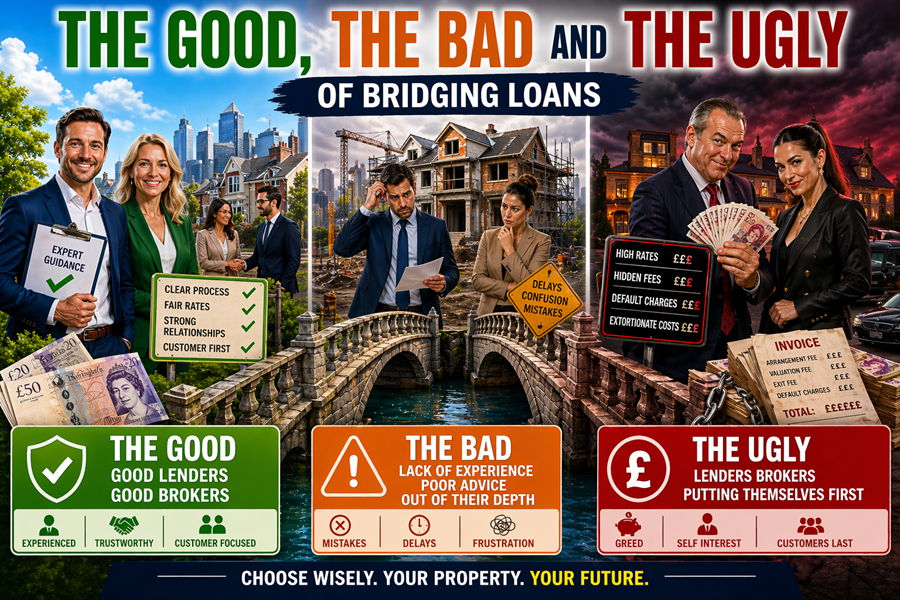
Whether you are about to take out, thinking about taking out, or have already taken out a bridging loan, then this article could save you a lot of money and stress!


We have called it “The Good, the Bad and the Ugly of Bridging Loans” because, in our experience, that is exactly what exists within the bridging loan market.
There is a lot of good, there is also some bad, and unfortunately there is some ugly too, with many of the worst examples found in parts of the unregulated bridging market.
Bridging loans are often seen as expensive and risky. They have a reputation for high interest rates, contract catches, hidden costs and heavy penalty fees. These concerns are something we hear regularly, often from people who have either had a bridging loan themselves or know someone who has had a bad experience.
The bridging industry is mostly made up of good lenders, experienced brokers and well-structured products that can be extremely useful when arranged properly. Many lenders and brokers work hard to provide fair pricing, clear terms, good service and flexible short-term finance that mainstream lenders simply cannot offer.
But the reputation has been damaged by a minority of lenders, and some brokers, who focus more on short-term profit than long-term relationships. In those cases, fairness can be pushed aside, fees can mount up quickly, and borrowers can find themselves in a far more expensive and stressful position than they expected.
This is why we have written this guide.
It is not designed to frighten people away from bridging finance. Quite the opposite as we happen to like this industry and have invested many years into it.
We believe bridging loans have an important place in the finance market, and when they are fair and consumer-friendly, they are a very useful form of funding.
No other area of finance combines speed and flexibility, for large finance facilities, in the same way. Bridging can help borrowers complete property transactions, buy at auction, fund refurbishments, raise money against assets that mainstream lenders will just not consider, or solve short-term financial challenges where timing is critical. When borrowing is only needed for a short period, a bridging loan is usually the most practical and cost-effective solution, but only if it is arranged properly and on the right terms.
Bridging finance is still a relatively small and specialist part of the finance industry, where much of the lending is unregulated.
There are regulated and unregulated bridging loans, and it is important for borrowers to understand the difference. Most bridging loans are not written on regulated agreements. In fact, less than 20% of bridging loans are regulated. This means the majority of the market sits outside normal regulated mortgage lending.
This does not automatically make an unregulated bridging loan bad. Most unregulated bridging loans are perfectly suitable and are provided by reputable lenders. However, it does mean borrowers need to be more careful, because the protections, obligations and standards may be very different to what they have been used to or are expecting.
Last year, a little over one million residential mortgages and remortgages were taken out in the UK. On top of that, there were more than 1.5 million mortgage product transfers. In other words, there were over 2.5 million mainstream mortgage transactions.
Compare that with bridging loans, where over the same period approximately 4,500 regulated bridging loans and around 21,000 unregulated bridging loans were taken out in the UK. That is roughly one bridging loan for every 100 mainstream mortgage transactions.
There are also thousands more finance and mortgage brokers in the UK, than there are bridging loans taken out each year. As a result, many finance and mortgage advisers, even the very good ones, may have little or no regular experience of arranging bridging finance.
With bridging loans, experience and keeping up to date with the market really is important!
Bridging finance is not the same as a normal mortgage.
The lender, fees, legal process, valuation, exit strategy, interest structure, default charges, service levels and flexibility can all make a huge difference to the final loan facility. A loan that looks cheap at the start can become expensive later. A lender that looks helpful at the beginning may become difficult if things do not go exactly to plan.
This is where specialist knowledge is so important.
Our bridging team work on bridging loans all day, every day. We have been involved in this market for the past 18 years, and over that time we have seen the bridging industry grow, evolve and mature. It is now used for a much wider range of purposes, delivered more efficiently, and priced far more competitively, with interest rates now often in line with mainstream longer-term lending options.
We know most lenders and how they operate, which lenders are strong in different situations and which lenders provide a good service, fair terms and practical facilities. We also know which lenders we would rather avoid!
We are not saying that we are the only people who can arrange the ideal bridging loan, because we are not. There are other excellent bridging brokers, packagers, networks and lenders in this market. Many of them also care about doing things properly and, like us, want to see the short-term finance industry continue to improve and grow.
But there are also borrowers who end up with the wrong lender, on the wrong terms, paying far more than they needed to or would have had they taken a different application route. This is what concerns us.
At KIS, we arrange around 1 in every 74 bridging loans taken out in the UK. As a small to medium-sized brokerage, we are proud of this, but it also means most borrowers will arrange their loan elsewhere. For every client that we help, around 73 borrowers take a different route. This guide is for them too, to help them understand the market, ask better questions, and avoid the wrong lender.
The good news is that much of the bridging industry today is competitive, transparent and genuinely useful. It helps thousands of borrowers complete property transactions, fund projects and solve short-term funding problems.
Unfortunately there are still risks, with expensive lenders, poor practices, clever contracts, aggressive fees, unsuitable recommendations and situations where borrowers can often be taken advantage of.
This guide is here to help you understand both sides of this industry.
It explains what bridging loans can do well. It also explains what can go wrong, what to look out for, what questions to ask, and how to avoid the mistakes that we see far too often.
Our aim is not to put you off bridging finance. Our aim is to help you enter the market with your eyes open.
A bridging loan can be a very good solution, but only if you avoid the bad and the ugly.
Last updated: 07 May 2026 | © KIS Bridging Loans 2024 | Privacy Notice | Complaints Policy
We would like to hear from anyone who has had a bad experience, having taken out a bridging loan or an unregulated first charge loan.
For long term loans, this includes interest rate reductions not being passed on.
The more information that we have will help us better understand what borrowers are experiencing. Read More
All information shared with us will be treated as private and confidential and will not be shared with anyone outside of KIS Finance Limited.
Depending on the circumstances, we may also be able to offer guidance, comment on what has happened, or simply share our thoughts. If we believe we can help or advise you, we will let you know.
Any help that we do provide will be completely free of charge. Even if we help you achieve a better outcome or improved settlement, there will be no charge.
Please contact us if:
We are interested in knowing more about:
Borrowers with longer term loans – if you still have, or had, and old unregulated secured loan agreement taken out before the credit crunch in 2008, where the 13 year record low interest rates from 2009 to 2022 were not passed on. In other words if you had a loan that was not on a fixed rate taken out in 2008 or before, where the repayments or interest charges did not reduce despite the reduction in interest rates. Bank of England base rate was 5.25% in February 2008, 12 months later it was 1.0%, then dropped further, remaining under 1.0% for 13 years.
Contact us
Please use the form below or email ugly@kisfinance.co.uk in confidence, and tell us what happened and include as much detail as you can. Alternatively send your contact details and ask us to call you.